Whether you know it as the Miata or the MX-5, there is no denying that Mazda created a phenomenon with their little re-imagining of a British roadster. Since its introduction in 1989, close to a million Miatas have been sold in every corner of the world. Simple, affordable, and fun to drive, Miatas have long been embraced by automotive enthusiasts as a standard-bearer of driving fun. And with a new model coming later this year, it is fitting that we look back at where things all started.
I should say now that this review is of my first-generation (model NA) Miata. I owned the car from 2011 to 2012 and drove it thousands of miles in sun, rain, and whiteout snow. It was my only car at the time, serving as my daily driver for commuting and road trips alike. This review covers the Miata from that perspective, warts and all.
The author on the day the Miata was bought.
The hideous bumper bra was removed soon after.
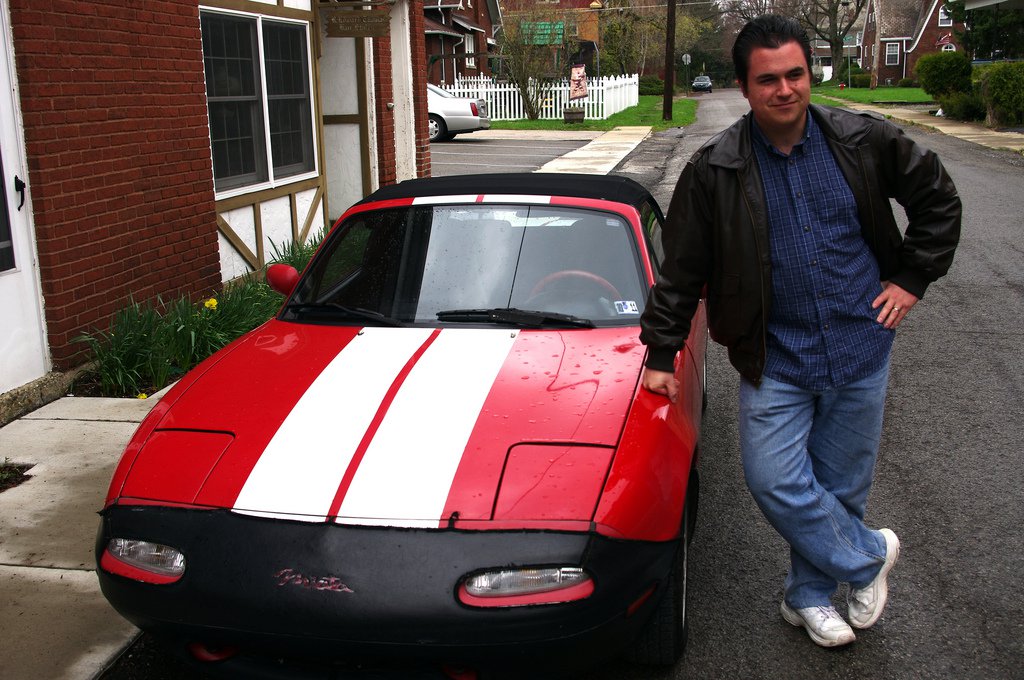
Built in 1993, my Miata was one of the last fully-manual NA’s built with the original 1.6 liter, four-cylinder twin-cam engine and no power steering. Later models of the NA moved to a larger 1.8L engine with 133 horsepower to the 1.6’s 115 bhp and power steering became a more popular option. But the combination of a manual transmission and manual steering is as old as cars themselves.
For those readers who have never driven a car with manual steering, let me explain. In a modern car, when the steering wheel is turned, a hydraulic pump or electric motor kicks in to help turn the front wheels. This means that even when making tight turns at low speeds (when there is greater friction to resist changing direction) minimal steering force is required and turning is easy. Manual steering has no such added assistance, as the only force turning the front wheels from side to side is the driver’s arms. This makes even light cars tricky to maneuver at low speeds and quite a real workout when parallel parking. To the average person, the decision to have power steering is an easy one. But there is a trade-off to the easier steering: loss of steering feel. By adding in an assist to the steering, there is an added insulation between the driver and the feel of the road through the wheel. Particularly with modern electrical power steering, the feeling of what the front wheels are doing is dulled. Manual steering allows the driver to get more feedback through their hands of what the front wheels are up to, and thus a greater feeling of connection with the car’s behavior and handling.
So, manual steering, rear-wheel drive. A fun combination on the back roads, a frustrating one when stuck in traffic. My little Miata lacked the Air Conditioning option when it rolled off the factory and, as anyone who has stood outside in 90-degree weather can attest, there comes a point when no amount of breeze helps cool your fevered brow. Creeping along in stop-and-go traffic with manual steering, manual transmission, and clutch can be a sweat-inducing pastime. Adding direct sun (or a black tent with the roof up) doesn’t help.
Speaking of manual transmissions, the Miata’s is a beauty. With a short throw between gears and a short linkage, it is the closest thing you can get to reaching into the transmission and moving cogs with your bare hands. The mechanical feeling of feedback is fantastic. Every other manual car, including the New Mini Cooper, has felt more removed from the shifting experience than the Miata. It’s truly a fantastic design that brings the driver directly into the action. However, there are still some trade-offs with the design. To keep the car feeling even remotely quick, the ratios are relatively close. While later models added a sixth gear, the NA made do with five gears. And with a close-ratio gearbox, and only five gears, the Miata struggled on the highway. Normal highway speeds saw the tachometer rise over 3500RPM, and spirited highway driving would cause the engine to jump on and off its 4250RPM power cam. For an engine that hits the limiter at around 6800RPM, this made for a loud and punishing highway ride for any journeys more than four hours or so.
But highway riding and comfort is not what the Miata is designed for. What the engineers wanted to recreate was the British back-road queens of the 1960’s and 70’s. That’s what the Miata really is, a Japanese copy of a British roadster. And at that task, the Mazda designers outdid themselves. The Miata sticks to the classic roadster formula of a small, front-engine car with rear-wheel drive and an open roof. A good back road is twisty and narrow, and that means faster cars with bigger tires and more grip can’t be safely taken to the limit. The Miata, with its small engine and small tires, can be fully used and enjoyed at safely legal(ish) speeds. And be assured, the Miata is definitely not fast. With a 0-60 time of 8.1 seconds, it’s literally slower than a Dodge Caravan (which goes 0-60 in 7.9 seconds). I remember feeling like a race car driver as I quick-shifted through the gears, only to look left and find myself being passed by an old woman in a minivan. However, for driving pleasure it is the sensation of speed, not the numerical speed itself, that really counts.
So, should you run out and buy an original Miata? No. Frankly, it’s too old to be a bargain anymore. The repairs will be constant and expensive as parts become less common and buying a newer model will end up cheaper in the long run. There are still gems tucked in among the Miata range from the last decade, and they are still some of the cheapest fun cars in America to buy used. Sure, the last few years have seen the Miata gain a few pounds and get a bit complacent, but hopefully the 2015 Miata’s claimed diet routine will have brought it back in line. And I, for one, can’t wait to drive it. I just hope Mazda brings some of the magic of the NA. I remember the fantastic feeling of working the engine through the gears and feeling the road through my fingertips and I hope the new Miata can live up to this. I know it dropped the America-only name of Miata and now wants to be called by its global name of MX-5, but I hope it still remembers how to have fun.
 The Grover Wheel
Leave a comment