What makes a motorcycle great?
It’s a question that has divided riders for over a century. For some, it is the ability to slice a corner like a scalpel. For others, brutal straight-line speed reigns supreme. Many look for long-distance comfort for touring. Harley riders look for whatever is shiny, loud, and is offered with easy financing.
Harley-bashing out of the way early, I want to ask a different question. What makes a motorcycle good? Does it have to be a specialist, unmatched in its category? Does it have to do multiple things well? Is it possible to be “good enough” in a world with near endless motorcycle choices?
Personally, I take Marie Kondo’s maxim to heart: “does this spark joy?”
For me, the greatest requirement I have for a motorcycle is to allow me to experience the many facets of motorcycle joy as often as possible. I love to road trip, I love to ride down a twisty back road, and I enjoy riding with my wife to explore new destinations or revisit favorite haunts.
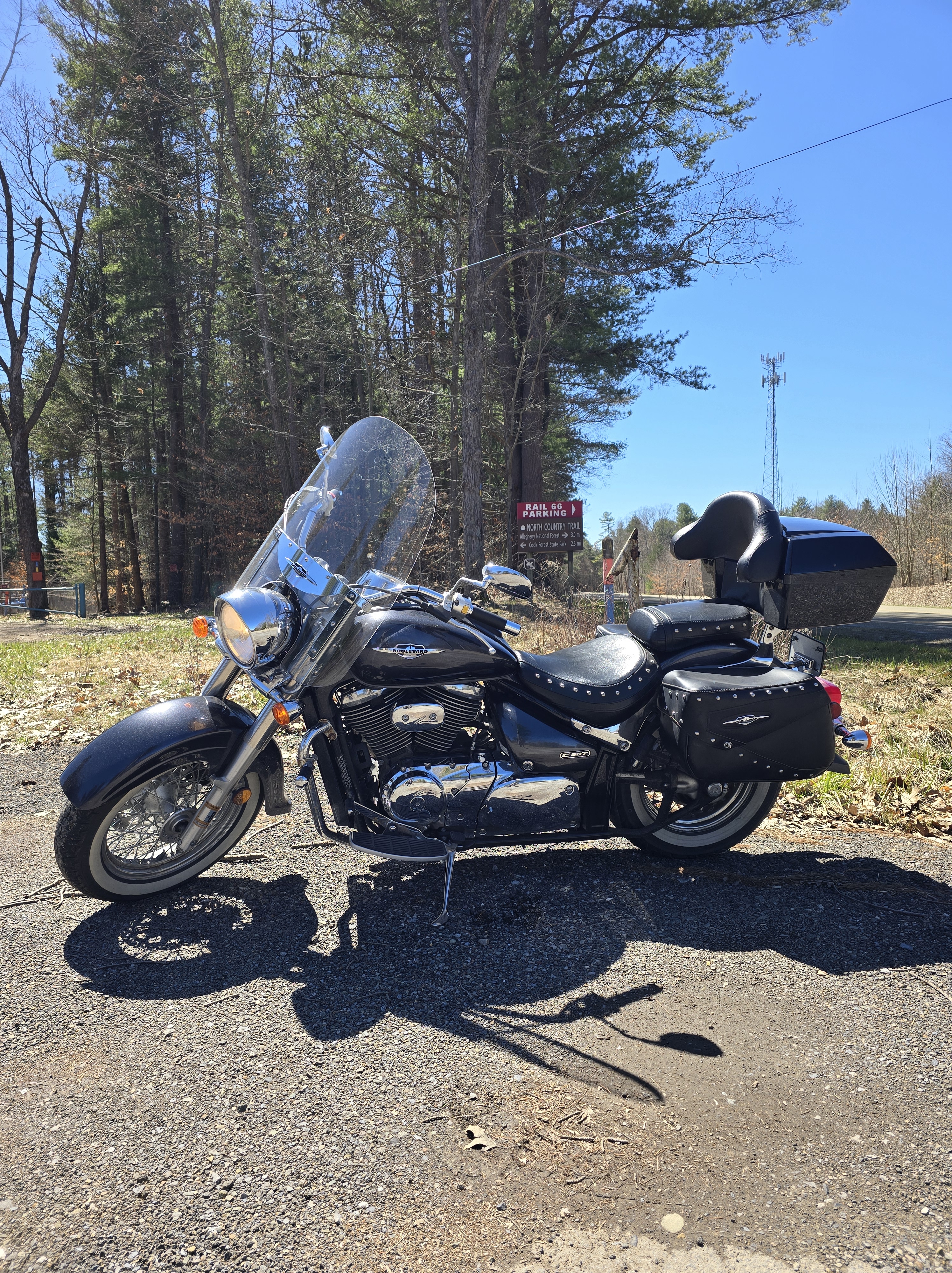
Enter the 2006 Suzuki Boulevard C50T. This particular motorcycle entered my life in a rather unexpected way. Ostensibly, it’s everything I always said I hated in a motorcycle: a heavy, slow cruiser built for old men to ride a sofa that makes farting noises louder than they do. My friend bought the bike last summer as his first motorcycle and, on our first ride out together, promptly rode it into a grassy ditch at about 14 mph. After a couple more rides (thankfully spill-free) he decided motorcycle riding was not for him (he prefers one-wheeled electric vehicles) and put it up for sale.
As luck would have it, I had crashed my own motorcycle just a month before he threw in the towel. My much-loved FZ6 met its end during a slippery morning commute to work when I introduced it to the back of a Subaru Outback. I survived relatively unscathed, the bike broke its back and my insurance pronounced it DOA. Sick of dealing with unreliable sellers and shady dealerships, I ended up purchasing my friend’s C50T out of a desperate need for a motorcycle to ride while I continued my search.
Having owned the bike for nearly six months and a couple thousand miles, I found my opinion changing. I started to see the appeal of the cruiser, a machine built for, well, cruising. It’s a surprisingly comfortable machine for a mid-size bike. Suzuki basically stuffed a 50ci engine (805cc) into a full-size bike frame and called it a day. I value reliability (remember the ‘often as possible’ part of my requirements?) extremely highly. Italian exotics are all well and good, but the most exciting machine in the world gets frustrating fast when it’s sitting at the dealer instead of running down the road. The Suzuki’s fuel injection and shaft drive means it’s ready to go at a thumb of the starter.
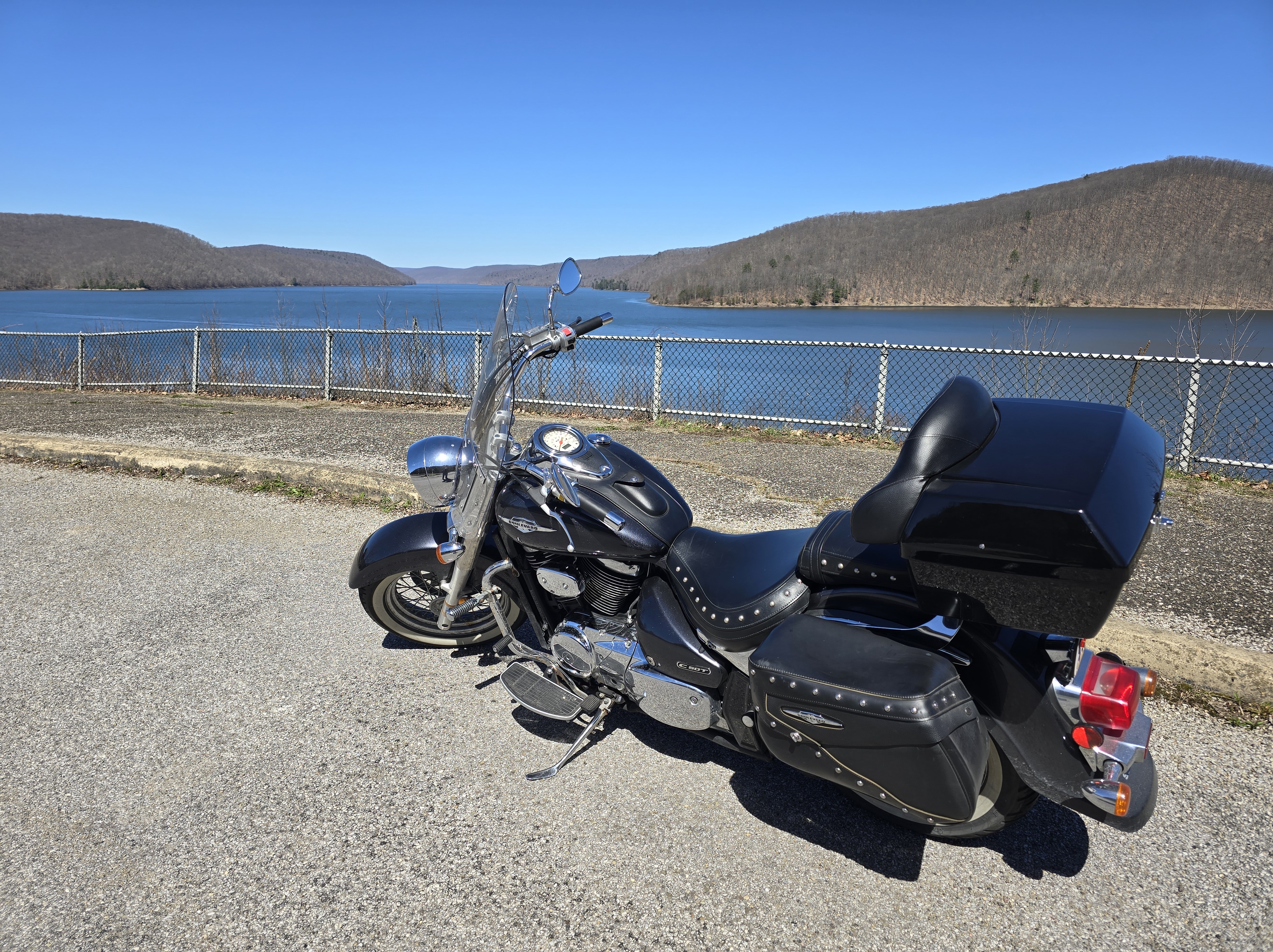
Practicality is its strongest suite. The aforementioned shaft drive and fuel injection are coupled with a moderate clutch pull and a relaxed rider triangle. The seat is wide and cushy and fits my 5’10” frame with room to spare. The C50 was offered in a range of models including the C50 (basic cruiser), M50 (muscle-bike styling), and the C50T I own (which included saddle bags, windshield, and floorboards from the factory). The C50T’s saddle bags are basic but functional and the previous owner had added an unbranded top-case to the luggage rack. The windshield is big and takes most of the wind off your body on long trips. The floorboards are wide and low down for a comfortable reach.
In fact, those floorboards sit too low. The bike’s single biggest failing is how easily the feeler pegs touch down and grind along the road. While softly sprung, with a tendency to float a bit when pushed hard in a corner, the C50T can handle leaning over much further than the floorboards will allow before it touches any more unyielding pieces of the bike. I have adopted a flat-tracker approach to cornering with my inside leg stuck out rigidly away from the bike while I just let the boards bounce around and grind. It is, however, easy to forget when taking a normal city corner and get kicked in the foot with an unsettling crunching sound. I would gladly give up a few inches of legroom for a few more degrees of cornering angle.
So it struggles in the corners, but I can mostly work around it. There is a certain perverse joy in muscling the heavy bike through corners at speeds it clearly doesn’t like. It’s like driving an old muscle car, but without the real muscle. It’s not dangerously slow, it keeps up with even highway traffic two-up with no problem, but it’s spunky-car-quick not bike-fast. But the flipside of that is I can wind through the gears at full-throttle without rapidly approaching triple digit speeds and the risk of incarceration. It’s a big old lab, bounding around the yard slower than the other dogs but having just as much fun.
Speaking of fun, my wife enjoys the more comfortable passenger accommodations than the sport-bike-derived slanted plank the FZ6 offered her. So those are three big requirements I laid out at the beginning all covered. And I will add a fourth: an underlying freedom from worry. With most motorcycles running over $10,000, and many running double or triple that figure, the C50T can be found on the used market for well under $3000. And it’s dirt-cheap to insure because, thank you old men, most of its riders rarely crash. A cheap bike with low running costs is not to be ignored. Every time I ride, I am free to wring that 50ci motor’s neck and put the bike away wet. I simply did basic maintenance when I got it and feed it the owner’s-manual-approved 87 octane every 100-120 miles or so. I get 44-50 mpg and, while the 4.1 gallon tank means I should get at least 180 miles, the lack of gas gauge makes me nervous.
Hooptie motorcycling has its advantages. Riding is what I love, and not worrying about excessive maintenance or costs means I spend more time in the saddle and less with a wrench. But have I become an old man with my slow, farty-noise bike? Possibly. But with age comes the freedom of not caring. Maybe those old men do know something after all.


 The Grover Wheel
Leave a comment