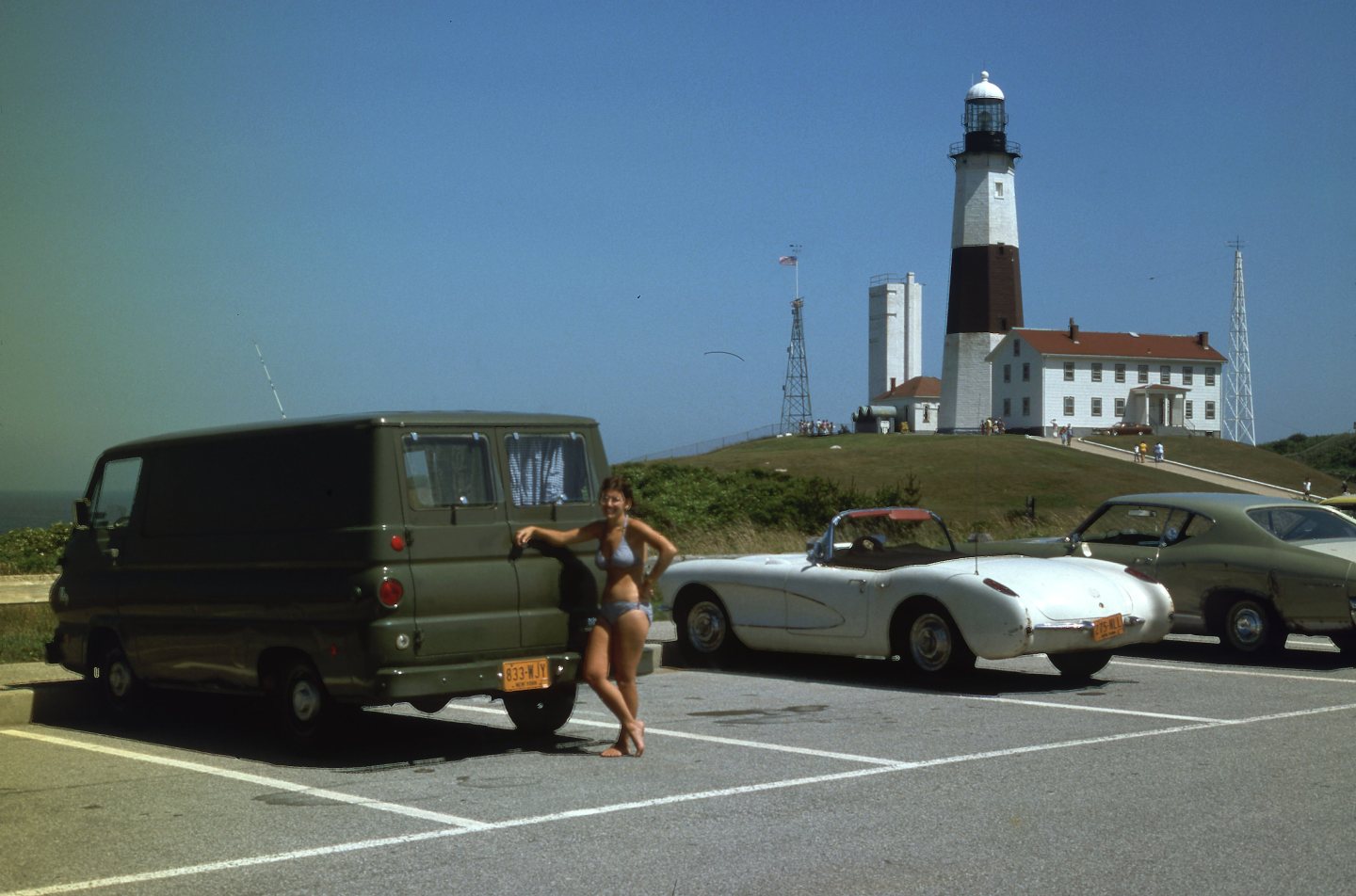
My dad was never one to miss the opportunity for instruction. As kids, we were never far away from what he would call ‘a life lesson’ and we kids would call ‘a lecture’. Many of these lessons were taken from his own misadventures and, truth be told, some of the stories were fun.
One I remember in particular was the wisdom of doing your research when making a purchase. The story of buying a used van in the dark (and rain) always stuck with me as one of Dad’s particularly poor decisions. The following story is his full account of their time with that particular van (a 1959 Dodge A100) and his many, many lessons in how a man may ‘buy in haste and repent in leisure’ on a vehicle.
Dodgeing Trouble in a 1969 Dodge A100
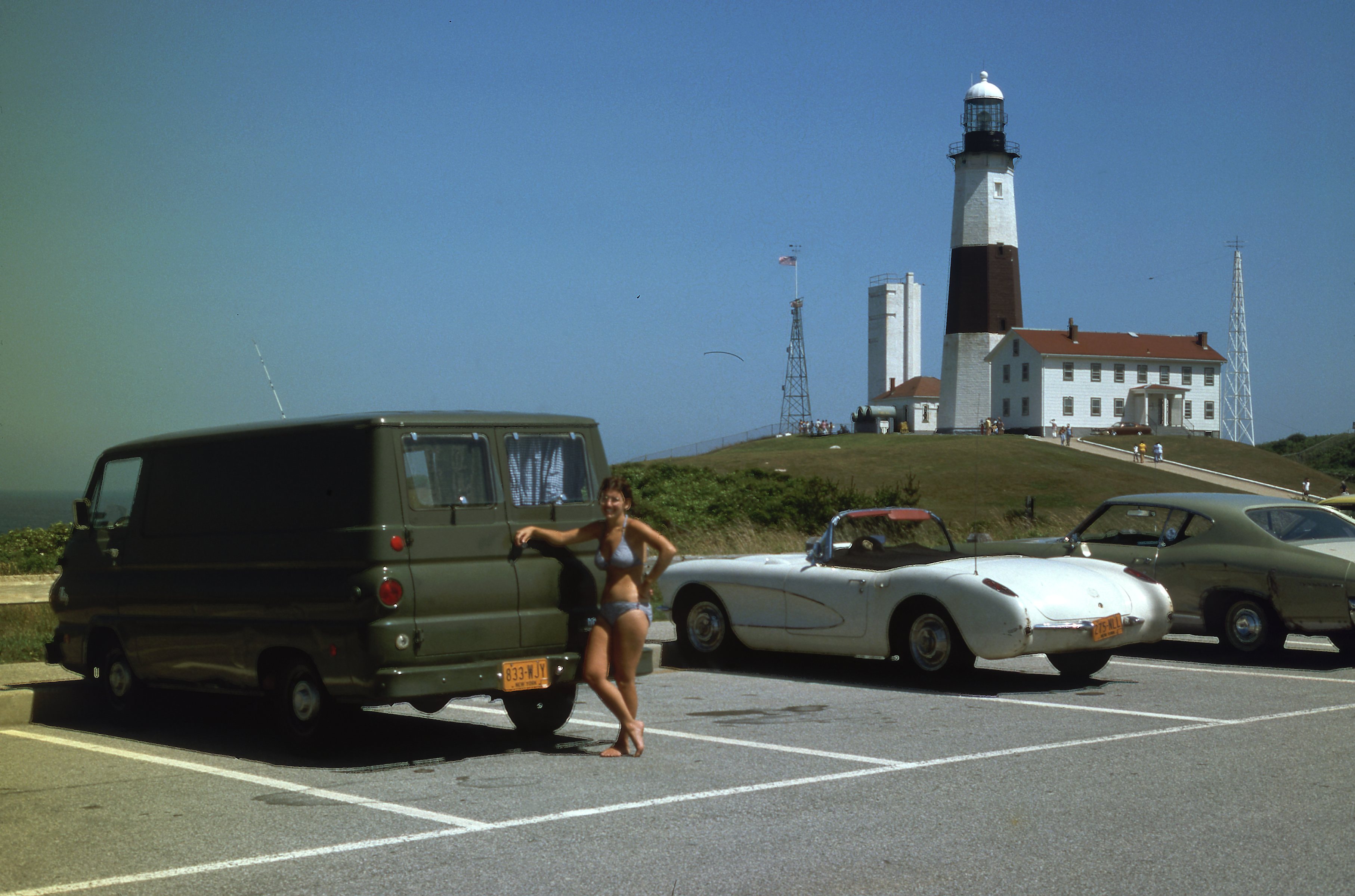
The date was summer of 1976. We had accepted my mom and dad’s offer to build on their piece of land in Medway. We needed a vehicle that could haul things like lumber and building materials. Decided on a van. For $500, we could own a used 1969 Dodge Telephone Company Van with a ladder rack. A vehicle that probably spent the last 8 years with the engine running 8 hours a day. We called and were told to meet at a random parking lot in the dark. I said, “Sounds good to me!” What was I thinking?!
My wife said, “What is that funny noise?” I said, “It’s probably nothing.” We paid the man anyway and began our learning experience. About two weeks later, we found out it needed a new engine. This would have been a good time to bail.
The garage installed a rebuilt Slant-Six. I think the original engine was a 170CI [editor’s note: I looked this up: it’s 101 horsepower.] and the new one was a 225CI [wow… up to 145hp!]. In the daylight I began to see rust holes all over the place. Thought, “I can fix these!” Another opportunity to bail missed.
So began an expensive learning time in cheapo, mickey-mouse body work. I bought some sheet metal after realizing the frame was just a bunch of bent sheet metal. I had to replace lateral pieces near the front and rear wheels. I fabricated u-shaped pieces and attached them with caulking and sheet metal screws. Holes in the rocker panels required plastic window screen and gallons of Bondo. Lastly, it was painted dark green with a brush. At least it was all the same color.
Holes in the floor were easy-ish to patch with flat stock, caulking, screws, and spray-tar undercoating. It became a regular Saturday night project in addition to other miscellaneous repairs. One day the gas pedal fell off.
After work on Friday Memorial Day weekend (or it might have been Labor Day), we decided to go camping somewhere on Long Island out towards Montauk Point State Park. Finally, we saw a campground. It was full, but the man said maybe we could stay for the night inside the nearby Military base. At the gatehouse, the man said “OK” since we were self-contained (which includes a bed and the porta-potty). If I remember right, he was distracted talking to a young lady at the time and not really paying attention to me.
Next morning, we learned that if you are a bona fide fisherman, you could spend overnight at the Montauk Point state parking lot. We went to a fishing gear store, bought a saltwater rod and a few lures, and a paper bag. We became bona fide fishermen. We even tried fishing, but the rocks ate most of the lures. That night, as we attempted to sleep virtually alone in a massive parking lot, some kind of weather front passed over us accompanied by thunder, lightning, heavy rain, and wind. It blew so strong that the van rocked on its worn suspension, striking fear that it might tip over or be blown into the sea. That may have been the end of my run as a bona fide fisherman. I decided to sell the rod.
Next, we bought a wooden construction trailer (a 8x16ft for $500) to transport and store belongings. The van’s trailer hitch was way too low, so I added a hitch ball to the floor inside the rear double doors. The height was just right. I ran wire and installed tail lights on the trailer and got an over-the-road temporary plate to transport it to Medway. We then loaded it with the last-needed items first and ended with immediate needs last. I think some of the stuff is still in the back of that trailer to this day.
We chose to move late at night in March. It was freezing cold in the cab as we were driving with back doors that were open to accommodate the hitch. Thank God we made it the 200 miles slowly over highways I-495 and I-95 without incident. When we got to Medway late, we slept in the travel trailer bought for use during construction. My wife and I framed the house with lots of lumber hauled in the van. After my wife and I toiled most of the summer, the house was weathertight and could be heated with the oil and gas cook-stove heater. We had water hauled from my parents’ well and power from an extension cord plugged into their house. Time to earn the money needed to have our house well dug, install a septic system, obtain our own power, finish the interior, and obtain a building occupancy permit.
My wife found a job working as a carpenter at what was called ‘a woman in a non-traditional role’ in Plainville, MA. and I became a surveyor’s assistant at the town of Medway. My wife would drop me at Town Hall in the morning and pick me up after work. In February 1978 it looked like it might snow. The weatherman implied it could be The Big One. It ended up as the infamous Blizzard of ’78. I can’t remember what we were thinking, proceeding as usual. My wife drove to work in Plainville after dropping me off and, about mid-morning, snow and wind began in earnest. About Noon, she called and asked if she should stay with her mom in Plainville or chance a trip home. I said. “give it a shot.” What was I thinking?!
Just for the record, the van had a fairly high clearance. We had also added four 60lb solid cement blocks over the rear axle and aggressive snow tires. It was a three-speed on the column, if that helps… I believe a prayer was involved, I know that much. With about eight inches of snow on the ground (and I-495’s pavement), she made it. Before the storm finally ended, there were three to four feet total on the ground. We walked on top of the snow with snowshoes.
Lots of stuff happened in the next ten years, many vehicles came and went (for various reasons). Some changes were mechanical, some financial, some purely functional. If I saw what looked like an opportunity to earn a bit buying low, fixing up, and selling higher, I would take a chance.
Enter the first Ford van. It might have been a 1975 work van I bought to sell. I still had the Dodge but noticed that, even with rust, the Ford was better. It was an automatic and had a full actual frame, unlike the bent body metal under the Dodge. The Ford’s engine was a 351 8-cylinder. My first Automatic 8. I decided to keep the Ford. In the end, I think we lodged about 50,000 miles on the rebuilt Slant-Six Dodge. By then, it was using a quart of oil every five hundred miles or so, even with oil changes every 2,000 miles. The Dodge finally was sold.
 The Grover Wheel
YES!! Your writing has improved…and thankfully you have retained your fabulous sense of humor ♡ as well as your automotive enthusiasm.
When that Dodge was sold, sadly the new buyer may have also later reflected “What was I thinking ?”